

Quality of Earnings Analysis
Every transaction rests on one number: what the business actually earns. A Quality of Earnings analysis tests that number independently — validating reported earnings, normalizing adjustments, proving out cash, and surfacing the issues that change price, structure, or loan size.
GCF’s Transaction Advisory team is CPA-led with forensic accounting expertise. We deliver earnings conclusions that stand up to buyer diligence, credit review, and investment committee scrutiny — because they were built to be examined.
Request a Scope and Fee Quote
Talk to our Transaction Advisory team
Deal Integrity℠ Starts With the Earnings Number
Most deals do not fall apart because someone disagreed about a multiple. They fall apart because the earnings number moved.
An add-back you can’t trace, revenue that bank deposits do not support, working capital that was never funded, owner compensation that was never normalized. Each one is small on its own. Together they reprice the deal — usually late, when the parties have the least room to absorb it.
Deal Integrity℠ means resolving those questions early, on a documented basis, so that everyone downstream is working from the same defensible foundation:
Reported financials → validated, normalized earnings → supportable value → financing and structure that hold
When that chain is intact, the transaction moves. When it breaks anywhere along the line, someone pays for it in price, in equity, or in time.
What a GCF Quality of Earnings Analysis Covers
Our core scope is built around the four areas that most often move a deal.
Cash and financial validation
Proof of cash, tax return reconciliation, and financial accuracy review. We tie reported results to bank activity and filed returns rather than accepting them at face value.
Working capital and balance sheet
Working capital analysis and A/R and A/P aging, so the level of working capital the business actually needs to operate is known before it becomes a closing dispute.
Transaction risk and trends
Customer and vendor concentration, plus three years of history with interim and trailing-twelve-month analysis to show whether performance is a trend or a moment.
Additional capabilities available by scope: additional entities, revenue stream analysis, projections, expense validation, and ARR, backlog, or WIP analysis.
“The objective of the QoE analysis is to assure our clients have greater visibility into the quality of a company’s financial statements and the run rate of cash flow on a go-forward basis.”
Quality of Earnings and Business Valuation, Coordinated
The earnings conclusion drives the value conclusion. When unrelated providers perform those two workstreams on different assumptions, the deal ends up with two earnings numbers and no reconciliation between them. GCF performs both.
One engagement. One information request. Two deliverables.
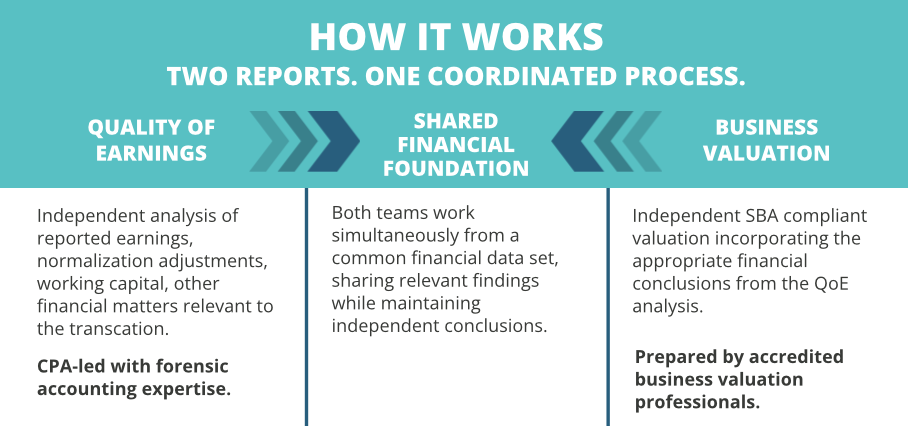
Independence is preserved on both sides — the conclusions are reached separately. What is shared is the underlying financial record, which is why the two reports reconcile instead of contradicting each other, and why one information request replaces two.
When SBA Financing Is Involved
For change-of-ownership transactions financed through the SBA 7(a) program, an independent Quality of Earnings analysis is now part of the requirement set on larger acquisitions, alongside an independent business valuation. The report must be independent of the buyer and the seller and prepared for the benefit of the lender.
Practically, that means two things for anyone bringing a deal to an SBA lender: the diligence needs to be sequenced earlier than it used to be, and the earnings figure that comes out of it will be the figure the loan is underwritten to.
GCF has served the SBA lending community for nearly 30 years and delivers both required work products under a single coordinated engagement.
What We Need to Get Started
Choose whichever is easier for your client. Either path may require follow-up requests; the second is materially more efficient.
Option 1 — Document set
- Balance sheet and P&L — last 3 years plus TTM
- Trial balances and general ledgers — last 3 years plus TTM
- Bank statements — last 2 years plus TTM
- Tax returns — last 3 years
Option 2 — Accounting system access
- Read-only access to the accounting system (for example, accountant access to QuickBooks Online)
- Bank statements — last 2 years plus TTM
- Tax returns — last 3 years
Why the Analysis Holds Up
We don’t automate this work or cut corners. Every engagement is staffed with credentialed professionals, and the conclusions are documented well enough to be examined line by line.
- CPA-led, forensic-grade financial analysis on the Quality of Earnings side
- Accredited valuation professionals on the valuation side, holding designations including ASA, ABV, CVA, CBA, and CPA
- Nearly 30 years working with lenders, brokers, and transaction professionals nationwide
- Machinery and equipment appraisal capability in-house (CMEA, EECA) when assets are material to the deal
- Offices nationwide, serving clients from small community banks to the largest institutions in the country
Frequently Asked Questions
An independent examination of a company’s reported earnings to determine what the business actually and sustainably earns. It validates adjustments to earnings, reconciles reported results to bank activity and tax filings, tests working capital, and identifies risks such as customer concentration that could affect earnings after a change of ownership.
An audit provides an opinion on whether financial statements conform to accounting standards for a historical period. A QoE is transaction-focused: it asks what a buyer, lender, or investor can rely on going forward, and it examines the specific adjustments and cash flow assumptions the deal is priced on.
Earlier than most parties assume. Pre-LOI or early post-LOI work gives you room to resolve issues while the timeline is still flexible. Waiting until lender underwriting means findings arrive when price and structure are hardest to change.
Yes. Validated, traced adjusted EBITDA is far stronger support for a listing price than a seller-prepared adjustment schedule, and it reduces the likelihood of a retrade during buyer diligence.
No. They answer different questions — what the business earns versus what the business is worth — and on SBA change-of-ownership transactions both are required. The two are most useful when coordinated, because the valuation should be built on the validated earnings.
Yes, and we recommend it. One engagement, one information request, two independent deliverables built from the same financial foundation.
A reconstruction of cash receipts and disbursements that reconciles bank statement activity to the income statement and the tax return for each period reviewed. It is the most direct test of whether reported revenue and expenses reflect what actually happened.
Reliance follows the engagement. For SBA and other lender-financed transactions, the engagement runs to the lender, and the report is prepared for the lender’s benefit. For sponsor, aggregator, and private credit engagements, the report is prepared for the acquiring or investing party.
Scope drives fee. We confirm scope, fee, and turnaround in writing before work begins, so there are no open-ended engagements.
Get the earnings and the value right before the deal is under pressure.
Whether you are underwriting a loan, preparing a listing, or evaluating an acquisition, we will scope the work and confirm fee and turnaround in writing.
Talk to our Transaction Advisory team about a deal in process
Keep learning:
GCF’s Business Valuation Accreditations
Your GCF Business Valuation appraisal team has one or more of the following business valuation accreditations:
 Accredited Senior Appraiser (ASA) – is recognized as having achieved the highest level of education, training, and report writing for business valuations. The ASA designation is the gold standard for a business valuation professional. (source: American Society of Appraisers)
 Certified Business Appraiser (CBA) – a very prestigious credential in the eyes of all who are familiar with it as it has earned the reputation of being a difficult credential to obtain. (source: National Association of Certified Valuators and Analysts®)
 Certified Valuation Analyst (CVA)
 Accredited in Business Valuation by the American Institute of CPAs (ABV by AICPA) – a credential granted exclusively by the AICPA to qualified valuation professionals who demonstrate expertise in valuation through knowledge, skill, experience, and adherence to professional standards. (source: American Institute of CPAs)
- Accredited in Business Valuation (ABV) – credential is granted exclusively by the AICPA to CPAs and qualified valuation professionals who demonstrate considerable expertise in valuation through their knowledge, skill, experience, and adherence to professional standards. (source: American Institute of CPAs)
- Certified Public Accountant (CPA)
Over 25 years of experience and expertise in business valuations and appraisals. An accredited appraiser receives extensive training, remains in good standing, and follows specific industry practices to determine the value of a business.
GCF’s Machinery and Equipment Appraisal Accreditations
 Expert Equipment Certified Appraiser (EECA) – Our appraisers are recognized with a deep understanding of valuation principles and extensive experience by the Institute of Equipment Valuation.
- Certified Machinery and Equipment Appraiser (CMEA) – a CMEA professional has the expertise and certification to conduct a third party machinery and equipment appraisal.
The GCF Business Valuation Process
