M&A Unplugged: Steve Mize, ASA: Business Valuation, What You Need To Know, Episode 39

Listen to the Podcast Here
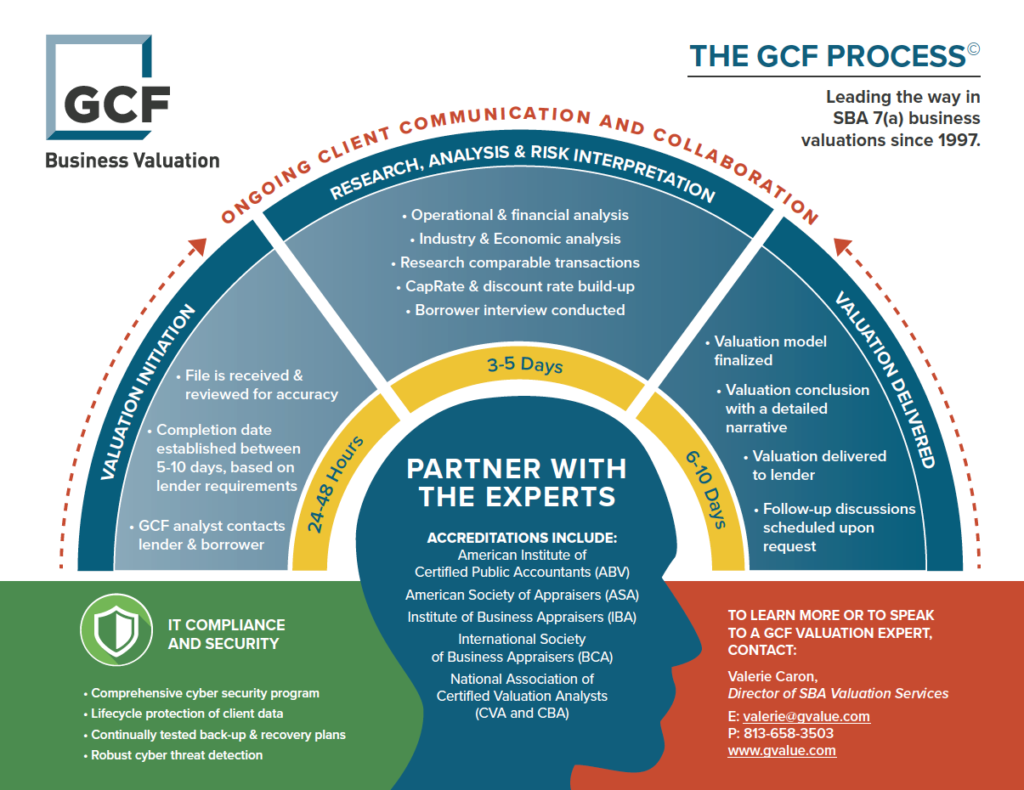
Or, Read the Transcript Below to Learn How GCF Builds SBA Business Valuations
Host: This is Small Biz Florida, the podcast designed and produced specifically for Florida’s small business owners and entrepreneurs. Small Biz Florida, talk that works for Florida. This podcast is supported by the Florida SBDC Network, providing the tools, strategies, and expertise to help Florida’s business community thrive. Visit the Florida SBDC online. At www.floridasbdc.org or contact your local office and get started on your path to success today. Host: This is small biz Florida, the podcast and broadcast. It’s all things business across the state of Florida. You know, I’m Tom Kindred and you know where we’re at. The FLAGGL Conference in Orlando, Florida. It is the Florida Association of Government Guaranteed Lenders. So, it’s all about small business lending, capital access, and, and all the support pieces that go along with that, uh, for two days. Um, you, you gotta kinda be an SBDC person to love a conference like this, but we love it. Uh, because it is all about trying to get access, uh, to capital, uh, to small businesses to help them start to grow and expand. So, uh, been a couple of great days. Talk to a lot of great people. And we’ve got one of those, um, very innovative, uh, important and valuable resources with us right now. We’ve got Darren Mize, who is the co founder and partner at GCF Business Evaluation. Um, Darren, welcome to Small Biz Florida. Darren: Great to be here. Thank you. Host: Um, so, uh, in talking to you and getting prepared for this interview, uh, I think one of the quotes we heard was you literally wrote the SBA’s business valuation operating procedure. No one knows them better than GCF. Uh, we appreciate your time and coming on and talking about, uh, business valuations because they are an important element in all of this, right? Darren: It is. And we, we certainly like to spread the word. I mean, our, our mantra is we keep small business moving. Uh, we’re passionate about entrepreneurship. We’re passionate about small business, uh, because there’s so many things that go along with that, that a lot of people don’t understand. So anything we can do to help. Host: Well, good. We’re going to get into that. Uh, let’s start with, uh, first, uh, just a little bit of background, uh, on yourself and kind of your pathway to, uh, uh, to GCF. Darren: Great. Well, uh, you know, we’ve been doing this for 25 years. Um, we’ve started out very small. We’ve, we felt like there was a need, uh, to help small businesses do an adequate valuation for a transaction. And at the time. There were so many companies out there that did that work, but they were charging 25, 000, for, you know, a proper valuation. Small business owners just can’t afford that. So we felt like it was a good idea to start working with the people who work with small business owners, specifically those who were involved in those small business transactions and provide a service that allowed them to adequately Put a value on a business so that they can sell it at the proper price. Makes it fair for both the buyer and the seller. And, and we, we started out with the M&A advisors and business brokers, and that led to SBA lenders and, and, uh, you know, uh, we’ve been doing this now for a long time and it’s, it’s keeping us busy. Host: So let’s, uh, let’s dive right into it. I mean, um, why does one, uh, need a business valuation? I mean, what, in what circumstances do we need one? Darren: Well, it could be any number of things. And, and I think that’s a, another misconception about, uh, small business owners and the people advise them is that a business valuation can serve all purposes, but it really can’t. Um, whether it’s exit planning, SBA lending, Gifting an estate tax, divorce, employee stock ownership plan. I mean, there’s, there’s probably a dozen or so reasons why somebody would want to have a valuation, but that the crux of it still remains that the business owner needs an accurate benchmark so that they can properly make a decision as to how they want to proceed with whatever it is that they’re trying to do. And that’s what the valuation does. And as long as it’s coming from an accredited professional, an accredited professional, um, they know they’re getting quality advice. Host: And I guess, um, when it’s always with the, when the requirement for the business valuation really is, is when you’re either buying or selling a business and you’re seeking SBA funding and financing, the SBA is always going to require some. Darren: Exactly. And, and what they require is actually that the valuation, the two key components to that. One is it has to be prepared by a qualified professional with an appropriate designation. And two, it has to have and be in a certain format to meet SBA guidelines and SOPs, uh, which you alluded to earlier, we help write all of those guidelines to make sure that the people that were doing the work, we’re doing it right. Host: Nice. Okay. Talk to us about the, the process. How does all this, uh, start and how does it flow? Darren: Well, it’s, it’s a fact finding mission. Uh, we know that small businesses and every small business is different. It’s do the proper diligence and time and effort and and preparing evaluation is accurate and that that comes with some time. So you’re, not only are you gathering a lot of financial data and a lot of operational information from the owner of the company, but you’re also taking that information and you’re. You’re doing a risk analysis to determine the risk of the company because risk and cash flow obviously are the key drivers of value. So the process, um, you know, can be anywhere from a couple of weeks to a couple of months. It really does depend upon the purpose and how the valuation is being used. So anybody who’s going to come and tell a business owner, you know, I can do this for you in three or four days or six days, they’re not giving that business its proper time and effort. And you know, a business owner needs that because if every business is different, you want to make sure you capture the value that that business has and you can’t do that in a few days. It’s got to take some time. And so obviously anybody, any qualified professional can guide you in that right direction. But when that qualified professional is telling you they can do it in anything really less than 10 days, I don’t think the business owner is getting what they deserve, right? Host: And and talk to me about, so we understand we’re we’re gonna get an SBA loan to buy a business got to have the valuation. We’re Engaged in a in a merger and acquisition of a business. We want to know is the buyer. What’s the business really worth? Is there a? Is there any, um, uh, reason why a business owner who’s operating, owning, you know, managing a business is, is this something that, that would be a value for a business owner just to have done, um, you know, every five years to really understand what his business is worth or can you really get that information from the balance sheet? Darren: Well, it’s two separate questions. Actually, one is, is the idea of, of a business owner having that kind of information is important for one. It could be just for exit planning. You know, if you’re, if you’re planning at some point to exit, you want to make sure that not only do you know what the valuation is today, but what it’s going to be when at the time that you exit. And on top of that, how do you get from point A to point B? So if a business owner needs or has targeted a certain number That they want to sell the company for and you’re not there yet. How do you get there? And the valuation advisor can certainly help you with that. Um, yeah, the balance sheet really is, is more of a, is a foundation for the company as a whole. Those are the assets and liabilities that contribute to the ability for the company to sell its products and services, which generate the revenue, which generates the cash flow, which then generates the value. So they all work hand in hand with each other. The income statement and the balance sheet are really one engine that creates the cash flow that generates the value for the company. So the valuation advisor is going to provide that business owner with an understanding of what they have. Perhaps maybe even what they need, uh, and provide them with a nice roadmap as to how they can achieve what they’re trying to achieve, whether it’s next year, next month or 10 years from now. Host: I love that, that insight because I think that incredible way to look at it is here, here’s our target, what we’d like to maybe exit. And the valuation can really give us that roadmap to get there because that’s a, that’s a, that’s a, that’s a complex question for a small business owner. You know, I want to sell this business for a million dollars, but it’s really only worth half a million. Well, how do I get there? They think it’s worth a million. And I think that’s the other, that’s the other section of the process here is that the valuation is going to realign that expectation because most business owners, rightfully so, by the way, because not many people know how to do this kind of work. Um, They think their business is worth X because of all these things, where in fact, most of those things really have no impact on value at all. You know what I mean? The sweat equity, obviously, is one thing that business owners like to talk about, but sweat equity has no bearing on values. More like sunk cost. What, um, but, but again, you bring up another great point. I mean, um, what are they? The aspects and bullet points of of a valuation, of course, we obviously know the obvious ones, you know balance sheet cash, but what do you look at in terms of the market and maybe trends and uh growth potential? Darren: Those are all factors that that are part of this algorithm absolutely, and so you’re looking at the Uh, the, the financial operation and the foundation for value, which is really just the numbers, right? And that’s, that’s a factual picture of the company. But then, then I go back to the same concept. You’ve got cashflow and risk. The two primary drivers of value, the risk is the perceived part of that equation. The cashflow is the factual side. So you’re looking at industry, you’re looking at financial trends. You’re looking at the dependency on the owner, or key employees. You’re looking at, you know, cashflow. And why you don’t, you’re not looking at revenue so much. You’re looking more about cashflow and, and maybe cashflow margin where I thought, where all that money is coming from, you know, are you, are you dependent on one customer that generates 80 percent of your revenue? Those are all, those are all risk factors that drive the value or lack thereof in evaluation. Host: My gosh, that goes back to your point about. I mean, those are all, those are all deep dives into the business. You’re not going to do that in three days. It’s not possible. And, and of course, I’m going to share my, one of my favorite, uh, business sayings with you, since you brought, brought up the bit about cash being kind of factual, I used to love when we talked about profits and opinion, cash is a fact. Darren: Exactly. Exactly. Um, And again kind of lends itself to the whole valuation process. Yeah, you can you can tell me what a great business you have But, but you’re going to look at the facts here. Yeah. I mean, so the other aspect is, is that, you know, the valuation and really what you’re going to do with the valuation is, is a very emotional process, whether it’s gifting an estate tax, whether it’s transaction, exit planning, all that kind of stuff. Our job is to take the emotion out of it, look at the facts and identify where those facts will take you in terms of value and how to improve upon where you are today versus where you want to be tomorrow, next year. So. Yeah. Uh, our job is to help the small business owner determine that so that they have, again, an adequate path to get where they need to be so that they can enjoy the rest of their life at some point. Host: Yeah, so let’s talk about logistics. Um, you do this all over the state of Florida. You do it all over the country. Um, how does one start the process of getting engaged with your company? Darren: Uh, we’re based out of Tampa, Florida. Uh, we’ve been doing this for 25 years. And the best way to reach us really is if you go to our website, which is gvalue.com, um, there is a spot there under contact us to be able to just reach out to our folks, uh, in Tampa and say, look, I’m interested in, in getting evaluation for this particular purpose. How can you help me? And somebody from our operations team and engagement team will reach out to them and give them a headstart as, as to how to make that happen. Host: What is the, uh, What’s kind of the strategy, uh, with a valuation? If I’m buying a business, do I want to engage you to get the valuation before I go into negotiations? Um, if I’m selling the business, do I, and we’ve, I think we’ve talked about that. That helps if you’re selling it because then you, you understand what the value really is. And I’m assuming in a, in an M&A deal, both parties might do their own valuation. Darren: It’s, it’s possible. You don’t, especially with small business transactions, you don’t see that much. Um, it’s certainly the right way to go. And obviously we advise a lot of our M&A side clients that evaluation is important because you need to help set that expectation of value right now versus when you go out and try to sell it on the buy side of the equation. It’s important to make sure that nobody overpays for that business. We want to make sure that it’s fair for both parties, both buyer and seller. So having evaluation as a buyer is going to help you determine how to approach that negotiation. Everybody has their own perception of risk, right? So the number that we come up with, you know, might be slightly off based on what they believe is risk versus what we believe is risk. It’s an opinion. But it’s coming from a qualified source. So it’s not like we’re going to be that far off. It’s just a matter of what that perception of risk is going to be. Host: Right. Um, what are you seeing in the, in the marketplace right now? Are you, are you, are you busy to the point where, wow, there’s a lot of buying and selling going on, or is that where we are in the marketplace in Florida? Darren: Well, we’re you know, we’re fortunate enough to know because of the experience we’ve had in the market over 25 years to see really what happens in the marketplace. So barring any major changes in economic structure whether you’ve got you know, we’ve seen 9/11 We’ve seen the Great Recession now. We’ve seen COVID. If you take those out of the equation, which are uncontrollable influences on the market, the market itself really doesn’t change that much in terms of small business transactions. So, you know, obviously after COVID coming out of COVID in that second half of 2020 things really came back to normal. Transactions were pumping. The U. S. Government was certainly helped fueling that a little bit. Companies did very well towards the end of 2020 and did very well towards all of 2021. Things are pulling back a little bit in terms of performance based on every company that we’re looking at at this stage. But overall, transactions continue to happen. It’s a great market, even with interest rates rising, people are buying companies or selling companies. So we’re certainly seeing the benefit of that. Host: Are there, do you see, do you see opportunities? I mean, do you see, uh, you know, of course, everybody talks about the pandemic, you know, third generations, I’m done, I’m tired. I, you know, I want to get out of this thing, you know, pandemic, you know, beat me up pretty bad. Are you seeing some of that going on and does that generate opportunities for young people to acquire businesses? Darren: It’s a great point. I, I would tell you specifically after COVID hit, there were a great many of opportunities out there. People just didn’t want to have to try to rebound and recollect, uh, you know, what they’ve been doing for a while because everything just kind of stopped for a couple of months. Uh, there were some really, really hard hit industries, especially in entertainment, hospitality, um, that created some nice opportunities for some buyers out there. Uh, it also created opportunities for entrepreneurship. Uh, and, and filling gaps of things that nobody knew where it was going to happen. And all of a sudden now there’s a market for something, uh, to prevent maybe that from happening again. So we saw it all from both sides, good, good and bad. Host: Do you, do you see any of this new, uh, model and I don’t know how new it is anymore. Uh, it’s probably now old, but the entrepreneurship through acquisition model where someone goes in, says, look, I’m going to work for you for a couple of years. I’m going to help grow the business and then take you out. Do you, are you seeing any, any of that kind of model at play in the marketplace? Darren: Well, you see a lot of that in private practice. So for specific, uh, businesses like, uh, medical practices, dental practices, optometry, things like that, the common model is to bring somebody in out of college, train them, teach them, get them comfortable. And at some point create an exit strategy so that that person can take on and carry it, uh, you know, with other industries, it, it depends. It really does depend. Uh, but there’s a lot of entrepreneurs out there and an entrepreneur wannabes, uh, that. Uh, come out of college with something that they want to go out and prove and they want to do it on their own. And I think it’s a great marketplace to be able to do that right now specifically. Host: All right, uh, Darren Mize, the co-founder and partner of GCF Business Valuation. Again, um, so often in small business, uh, you know, you got these folks that have, you know, grown the business started growing it, you know, they’re in their fifties, sixties, seventies, there’s not, sometimes there’s not that understanding of, of these kinds of very, what I would describe as important and sophisticated tools and processes that you need to go through. I can’t imagine just having a conversation with somebody and saying, you know, yeah, here’s my balance sheet. I’ve got, you know, I’ve got, uh, $200,000 worth of shop tools and I got some trucks and trailers and, and, uh, you know, here’s what I’d like to sell my business for. It’s scary to think that some people, that’s how they do this and, uh, without what you do, which brings really a more accurate and professional level of, of, of selling that, that legacy business. Darren: Well, it’s, it is a professional job that we do, meaning that you have to have not only the knowledge and the expertise, but you have to have accreditation as well, whether you’re a doctor or lawyer, a CPA, you know, all of these professions have specific moral and ethics clauses that you have to follow throughout your career as well as designations that you need from training and continuing education on that training. So. Yeah, I mean, anybody can tell you you need to do this or need to do that. But if it’s not coming from a qualified source, you know, you need to be wary of that. Um, people, like I said, people have their own idea of what value is and where it comes from. But unless you’ve gone through, in my case, seven years worth of experience in the marketplace and another Full year of education and training on my designation, and then a peer review on top of that, you have to go through that to make sure that you’re giving that qualified advice to a small business owner. Because the important here is small business owners are in fact the ones who benefit or suffer when, when they exit, they’re not getting what they deserve in terms of value. And you need somebody to be able to make that an accurate valuation before they go out. Host: Nope. Makes absolute sense. And, uh, so, uh, Darren, thank you for the work you do. Thank you for your support of the, uh, FLAGGL conference. Uh, I think you guys win the nicest, uh, booth award. Darren: Thank you. Host: Uh, well, of course, you know, behind ours, of course, but, uh, but yeah, uh, beautiful presentation. Darren: And, uh, you can thank my marketing team for that. They’re, uh, they’re fantastic. They do a great job. Host: Listen, you, what you do is important. You’re helping, uh, legacy businesses, like you say, get, get what they truly deserve, uh, when they’re exiting those businesses. So we appreciate what you do. Darren: My pleasure. Happy to be here. Thanks for having me. Host: Yes, sir. Uh, so again, Darren Mize, co founder and partner of GCF business valuations. You can find them at gvalue.com. That’s great. All right. Thank you, Darren. Darren: My pleasure. Host: Keep up the great work. We appreciate it. Darren: Pleasure to be here. Host: All right. Uh, this is Tom Kindred and this is a small biz Florida coming to you from the FLAGGL conference in Orlando, Florida. Uh, stay tuned, uh, more to come. This is small biz Florida.
Keep learning about SBA Business Valuation
GCF’s Business Valuation Accreditations
Your GCF Business Valuation appraisal team has one or more of the following SBA business valuation accreditations:
 Accredited Senior Appraiser (ASA) – is recognized as having achieved the highest level of education, training, and report writing for business valuations. The ASA designation is the gold standard for a business valuation professional. (source: American Society of Appraisers)
 Certified Business Appraiser (CBA) – a very prestigious credential in the eyes of all who are familiar with it as it earned the reputation of being a difficult credential to obtain. (source: National Association of Certified Valuators and Analysts®)
 Certified Valuation Analyst (CVA)
 Accredited in Business Valuation by the American Institute of CPAs (ABV by AICPA) – a credential granted exclusively by the AICPA to qualified valuation professionals who demonstrate expertise in valuation through knowledge, skill, experience, and adherence to professional standards. (source: American Institute of CPAs)
- Accredited in Business Valuation (ABV) – credential is granted exclusively by the AICPA to CPAs and qualified valuation professionals who demonstrate considerable expertise in valuation through their knowledge, skill, experience, and adherence to professional standards. (source: American Institute of CPAs)
- Certified Public Accountant (CPA)
Over 25 years of experience and expertise in business valuations and appraisals. An accredited appraiser receives extensive training, remains in good standing, and follows specific industry practices to determine the value of a business.
GCF’s Machinery and Equipment Appraisal Accreditations
 Expert Equipment Certified Appraiser (EECA) – Our appraisers are recognized with a deep understanding of valuation principles and extensive experience by the Institute of Equipment Valuation.
- Certified Machinery and Equipment Appraiser (CMEA) – a CMEA professional has the expertise and certification to conduct a third party machinery and equipment appraisal.
The GCF Business Valuation Process