

Home Healthcare Services Business Valuation

Why Value a Home Healthcare Business?
Determining a Fair Purchase or Sale Price
The home healthcare sector continues to attract buyer interest due to aging demographics, recurring revenue models, and growing demand for in-home medical and non-medical care. But valuing a home healthcare business is far from straightforward. From reimbursement risk to caregiver turnover, many variables impact the fair market value of a home health care business. Whether you’re preparing for a sale, merger, acquisition, or financing, a qualified business appraisal by an accredited appraiser helps establish a credible value.
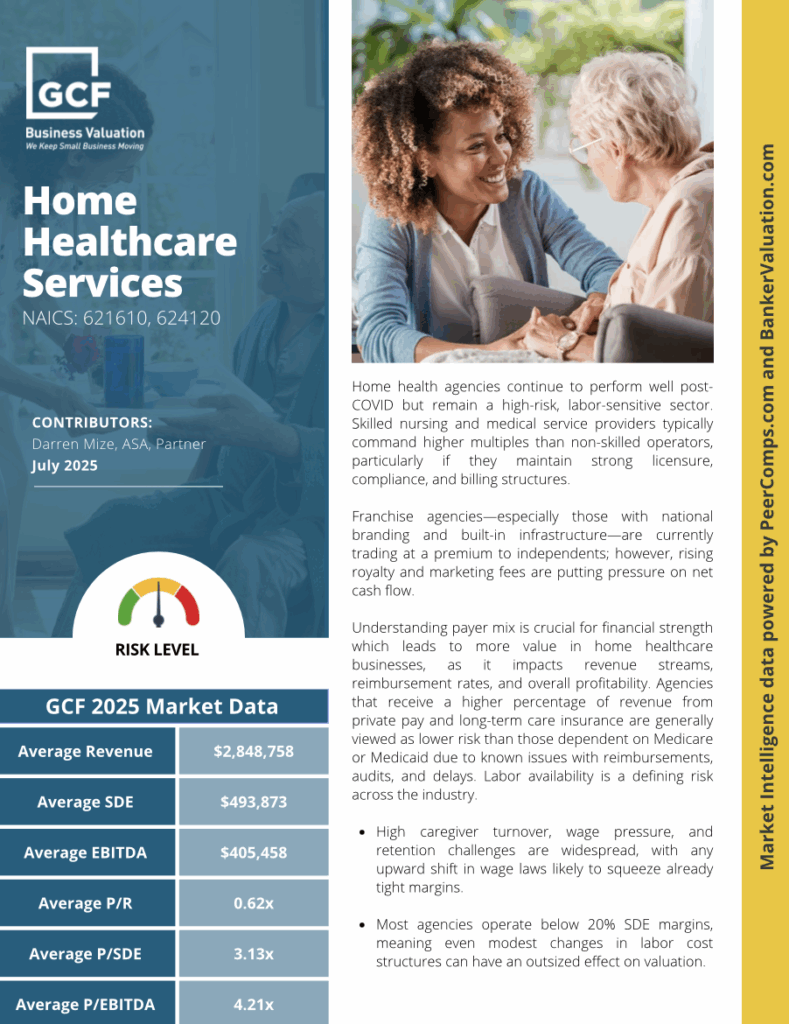
Today, the average home healthcare business generates $2.85 million in revenue, with average cash flow margins around 17%. Valuation multiples remain strong—averaging 3.13x SDE and 4.21x EBITDA—but only for businesses that can demonstrate regulatory compliance, strong payer mix, and workforce stability.
Strategies for Maximizing Business Value
Agencies offering skilled services (e.g., nursing, rehab, post-acute care) typically command higher multiples than non-skilled operators, especially if billing and licensure structures are well-documented. Franchise operators may benefit from national branding and support—but rising royalty fees and marketing costs often compress margins. The best way to improve value is to maintain clean financials, document your revenue per patient, and understand how your reimbursement model (Medicare, Medicaid, private pay) impacts perceived risk.
Supporting Investment and Exit Decisions
Whether you’re exiting the business or acquiring a new one, a professional valuation gives you clarity. Sellers avoid underpricing; buyers avoid overpaying. Most importantly, lenders and investors gain confidence in the numbers. In a labor-constrained industry with tight margins, valuation accuracy matters. Value is driven primarily by cash flow and risk—not generic rules of thumb—which is why income-based analysis and real transaction comps are essential when deciding to exit or acquire.

Key Value Drivers in Home Healthcare Services
Patient Demographics and Service Types
The services offered—skilled nursing vs. non-skilled care—significantly impact business value. Skilled providers often receive higher reimbursement rates and valuation multiples. Additionally, agencies that serve growing elderly populations with high care needs tend to experience stronger cash flow and lower client churn, which supports higher valuation through higher revenue, which increases margins.
Revenue Streams and Reimbursement Models
Payer mix is a key value driver. Agencies with a high percentage of private pay or long-term care insurance revenue tend to be viewed as lower risk. In contrast, heavy reliance on Medicare or Medicaid can reduce the perceived value due to audit risk, reimbursement delays, and rate fluctuations. Consistency is important in this area because predictable revenue makes it easier to plan ahead.
Regulatory Compliance and Quality of Care
Demonstrating regulatory compliance and tracking patient outcomes are essential to valuation. Buyers and lenders want to see that your agency is prepared for changes in healthcare law and payer audits. Quality of care impacts valuation directly—agencies with fewer complaints, lower readmission rates, and consistent survey results often command a higher multiple.
The Valuation Process Explained
Approaches to Valuation (Income, Market, Cost)
GCF uses a blended approach to determine the value of home care businesses, combining income-based methods (Capitalization of Earnings, DCF) and a Market Approach (transaction data from PeerComps). With ample transaction data for this industry, it’s common to see a 50/50 weighting on both approaches. The Cost Approach (asset-based) is rarely used because service based companies usually don’t have significant assets on the balance sheet.
Required Financial Documents and Data
To produce an accurate appraisal, owners should start by providing 3 years of tax returns (or 2 years plus a FYE P&L), a year-to-date P&L, staff/payroll detail, owner responsibilities, reimbursement breakdown by payer, equipment inventory, and any franchise or licensing agreements. Qualified Appraisers may come back with additional document requests or a few sets of Q&A, depending on what they see in the initial review of the working file.
Working with Accredited Business Appraisers
Home health agencies face scrutiny from lenders and regulators, so it’s critical to work with an accredited valuation expert—such as an ASA, CBA, CVA, or ABV. These designations assure you a qualified professional who understands the health services industry and the dynamics of small businesses and the M&A Market. Credentials matter.
Common Challenges in Valuing Home Healthcare Businesses
Impact of Regulatory Changes
Healthcare regulations change frequently and can directly impact agency profitability. Proposed changes to Medicare reimbursement or new compliance rules can materially alter buyer expectations in terms of projected revenue/cash flow, which impacts value. Buyers should be up to date on any regulatory/industry changes as part of their due diligence. They should not rely on the business owner to do this for them.
Staffing and Labor Market Issues
Home health staff retention is a critical risk factor, something that continues to be a challenge for this industry post COVID. High caregiver turnover, staffing shortages, and wage pressure all affect margins. Many agencies are faced with paying higher wages to maintain quality caregivers. But even small increases in labor costs can compress margins in a sector where cash flow margins are already below 20%.

Local Market Competition
Franchised agencies—like in many industries—tend to have an edge and often command higher values than their non-franchised counterparts. Buyers should have a clear view of the local competition landscape.
Next Steps: Get a Professional Business Valuation
Preparing for the Valuation Engagement
To start the process, gather your financials (include any income statement adjustments / “add backs”), owner responsibilities, staff rosters, service breakdown, and payer summaries. If your agency operates under a franchise model, include franchise agreements and fee schedules. These materials help ensure your appraisal accurately reflects your operational and financial reality.
Unlock More With the Industry Leader
Connect With GCF for a No-Gap Appraisal
GCF Valuation is the trusted source for home healthcare business appraisals—offering unmatched service, industry expertise, and deep transactional insight. Download our Market Intelligence Report to learn more, or connect with our team today.
How GCF Delivers Transparent Valuation Guidance
Expert Accreditations and Experience
GCF Valuation is staffed exclusively by accredited professionals with healthcare and small business experience. We’ve been valuing businesses for over 27 years, and because home health care agencies are extremely marketable to SBA Lenders, GCF’s SBA lending focus provides significant subject matter expertise in this industry.
Role of Transaction Data-Driven Insights
Our reports include peer comparison home healthcare benchmarks using transaction data from PeerComps. Sourced from SBA lenders who financed the transaction, PeerComps allows us to incorporate analysis grounded in real-world market activity.
Flexible Support for Complex Appraisal Needs
Whether you need a Machinery & Equipment Appraisal, Quality of Earnings, Add Back Tracing®, and/or Deal Ready Financials, GCF offers scalable valuation and transactional due diligence services tailored to the healthcare industry’s needs.
What to Expect from GCF’s Process
From start to finish, your assigned appraiser remains available to answer questions and ensure complete clarity.
Download and Equip Yourself with Industry Intelligence
Thinking of buying or selling a Home Healthcare Service Business? Don’t guess—get the data. Download our full Market Intelligence Report for Home Healthcare Services and talk to a credentialed GCF appraiser today.
Keep Learning About Business Valuations
How to Navigate The Business Valuation Process Successfully
The Great Debate: Business Valuation With or Without Inventory
What Is Business Valuation? Why & When You Need One
Our Accreditations
Your GCF Business Valuation appraisal team has one or more of the following business valuation accreditations:
 Accredited Senior Appraiser (ASA) – is recognized as having achieved the highest level of education, training, and report writing for business valuations. The ASA designation is the gold standard for a business valuation professional. (source: American Society of Appraisers)

- Certified Business Appraiser (CBA) – a very prestigious credential in the eyes of all who are familiar with it as it earned
the reputation of being a difficult credential to obtain. (source: National Association of Certified Valuators and Analysts®)
 Certified Valuation Analyst (CVA)
 Accredited in Business Valuation by the American Institute of CPAs (ABV by AICPA) – a credential granted exclusively by the AICPA to qualified valuation professionals who demonstrate expertise in valuation through knowledge, skill, experience, and adherence to professional standards. (source: American Institute of CPAs)
- Accredited in Business Valuation (ABV) – credential is granted exclusively by the AICPA to CPAs and qualified valuation professionals who demonstrate considerable expertise in valuation through their knowledge, skill, experience, and adherence to professional standards. (source: American Institute of CPAs)
- Certified Public Accountant (CPA)
Over 25 years of experience and expertise in business valuations and appraisals. An accredited appraiser receives extensive training, remains in good standing, and follows specific industry practices to determine the value of a business.
GCF’s Machinery and Equipment Appraisal Accreditations
 Expert Equipment Certified Appraiser (EECA) – Our appraisers are recognized with a deep understanding of valuation principles and extensive experience by the Institute of Equipment Valuation.
- Certified Machinery and Equipment Appraiser (CMEA) – a CMEA professional has the expertise and certification to conduct a third party machinery and equipment appraisal.