

Coin-Operated Laundry Business Valuation: Why Simplicity Drives Stronger Multiples
Few small businesses are as straightforward—and as attractive to buyers—as coin-operated laundromats. With minimal labor, predictable cash flow, and strong demand in urban and rental-heavy areas, these businesses often trade at higher cash flow multiples than many other small businesses. Whether you’re thinking of selling, buying, or securing SBA financing, a professional valuation can help you capture the full value of a business model that thrives on efficiency and consistency
Why Invest in a Coin-Operated Laundry Business Valuation
Benefits of Knowing Your Business Value; Don’t Leave Money on the Table
Because laundromats are often owner-operated and simple to manage, many sellers assume their business isn’t “worth much”—and price it based on gut feel, not performance. But with average multiples at 3.25x SDE (or better) and margins near 30%, even modestly performing stores can be worth more than owners realize. A formal valuation ensures you’re not undervaluing what may be one of your most valuable—and most overlooked—assets.
Spotting Opportunity as a Buyer
From the buyer’s side, this simplicity also creates opportunity. If a seller underestimates the value of their location, or cash flow—especially if they don’t have clean books or formal financials—it could mean you’re acquiring an undervalued asset. A valuation can help you assess what the business should be worth based on real-world comps and cash flow—not just what the seller believes it’s worth.

Key Moments to Secure a Professional Valuation
- Preparing to sell your laundromat
- Buying or merging with another operator
- Seeking SBA or conventional financing
- Refurbishing or Buying New Equipment
- Acquiring Real Estate
Essential Factors Influencing Coin Laundry Value
Location and Foot Traffic
Not all laundromats are created equal. Sites near apartment complexes, transit hubs, or areas with limited in-unit laundry tend to see stronger foot traffic which drives marketability up. Stronger foot traffic does increase equipment usage and therefore increases maintenance costs. Ample parking and signage visibility are also value boosters.
Equipment Age and Efficiency
Older equipment may still function, but it often results in higher utility bills and looming capital expenditures. Buyers will factor this into their offer price.
Financial Performance Metrics
Buyers and lenders look closely at Seller’s Discretionary Earnings (SDE) as the foundation for value. Coin laundromats typically operate at strong margins, with average SDE representing nearly 29% of revenue. This margin strength reflects low labor costs, high automation, and relatively stable operating expenses. Most successful laundromats generate consistent, recurring income with minimal staffing. But sharp increases in utility costs or rent can compress margins quickly.
Because coin laundromats are heavily cash-based, it’s not uncommon for owners to underreport revenue on their tax returns. While this may reduce taxable income in the short term, it has a major downside: it reduces the provable cash flow used to value the business.
Unreported Cash = Lower Value
SBA lenders and appraisers can only use verifiable, documented revenue in their analysis.
A business that “makes more than the books show” might still sell—but it won’t command top dollar, and it likely won’t qualify for full financing.
Data-Driven Insights for Accurate Valuation
Don’t rely on “rules of thumb.” Draw from real-time comparable transactions whenever possible. Using industry-specific metrics, apply valuation multiples that reflect current trends—not historical averages.

Choosing an Accredited Appraiser for Laundry Businesses
The Importance of Credentials
An accredited laundry business appraiser brings credibility and reliability to the process. Especially when third parties—like buyers (and their advisors) or banks are involved, the appraiser’s credentials are as important as the methodology used.
Guidelines for Selecting a Qualified Valuation Professional
- Verify credentials (ASA, CBA, CVA, ABV)
- Ensure direct experience with laundromat or coin-op businesses
- Confirm access to relevant market comps
Maximizing Value When Selling or Buying a Coin Laundry
Negotiation Tactics Powered by Market Data
Buyers want assurance that the business is priced fairly. Sellers want to protect their upside. Objective valuation reports—prepared by an accredited appraiser —give both sides the confidence they need to close.
Setting a Fair Purchase or Listing Price
Avoid underpricing by using a data-driven benchmark—not just a multiple someone heard at a trade show. Draw from real-time comparable transactions and industry-specific metrics, which will allow you to apply valuation multiples that reflect current trends.
Unlock More Insights: Download the Market Intelligence Report
Market Data for Real-Time Decision Making
This one-page industry overview offers practical valuation guidance for buying or selling coin-operated laundromats, prepared by accredited business appraisers with specific industry experience. It also includes PeerComps transaction data sourced from the SBA lenders who financed those deals.
How the Report Elevates Owner and Buyer Confidence
Our clients use the report to:
- Set realistic expectations before listing
- Support bank financing requests
- Justify price during negotiations
- Educate buyers unfamiliar with laundromat cash flow
Download and Equip Yourself with Industry Intelligence
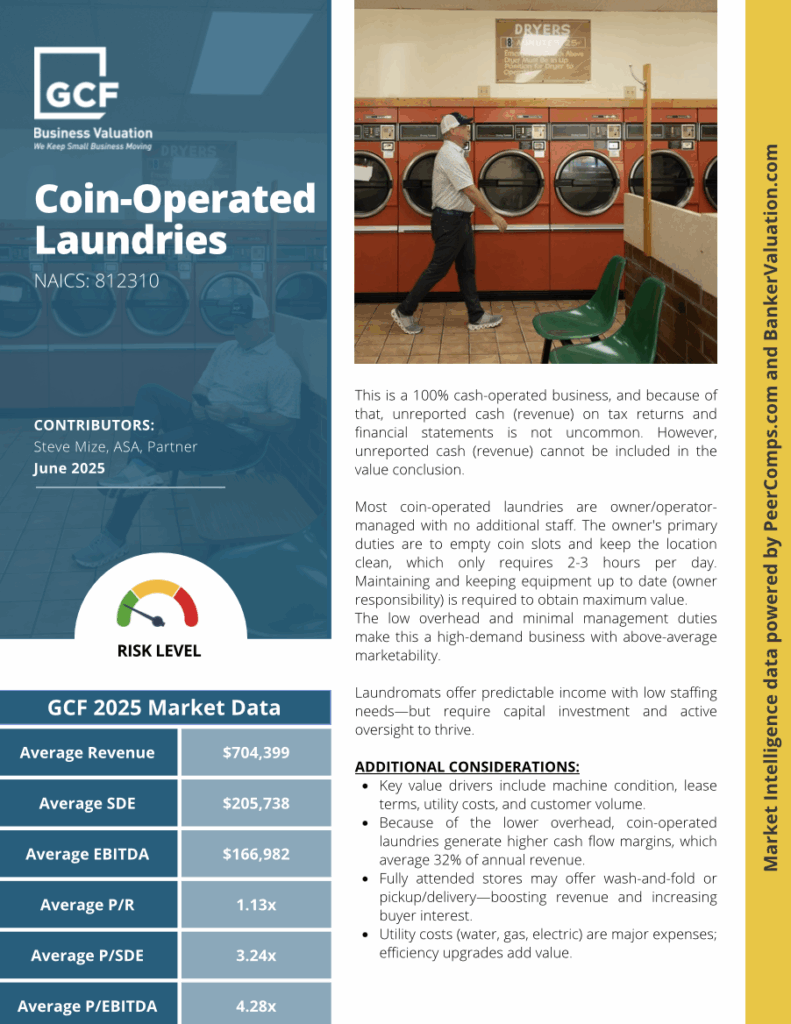
Thinking of buying or selling a laundromat? Don’t guess—get the data. Download our full Market Intelligence Report for coin-operated laundry businesses and talk to a credentialed GCF appraiser today.
Keep Learning About Business Valuations
How to Navigate The Business Valuation Process Successfully
The Great Debate: Business Valuation With or Without Inventory
What Is Business Valuation? Why & When You Need One
Our Accreditations
Your GCF Business Valuation appraisal team has one or more of the following business valuation accreditations:
 Accredited Senior Appraiser (ASA) – is recognized as having achieved the highest level of education, training, and report writing for business valuations. The ASA designation is the gold standard for a business valuation professional. (source: American Society of Appraisers)
 Certified Business Appraiser (CBA) – a very prestigious credential in the eyes of all who are familiar with it as it earned
the reputation of being a difficult credential to obtain. (source: National Association of Certified Valuators and Analysts®)
 Certified Valuation Analyst (CVA)
 Accredited in Business Valuation by the American Institute of CPAs (ABV by AICPA) – a credential granted exclusively by the AICPA to qualified valuation professionals who demonstrate expertise in valuation through knowledge, skill, experience, and adherence to professional standards. (source: American Institute of CPAs)
- Accredited in Business Valuation (ABV) – credential is granted exclusively by the AICPA to CPAs and qualified valuation professionals who demonstrate considerable expertise in valuation through their knowledge, skill, experience, and adherence to professional standards. (source: American Institute of CPAs)
- Certified Public Accountant (CPA)
Over 25 years of experience and expertise in business valuations and appraisals. An accredited appraiser receives extensive training, remains in good standing, and follows specific industry practices to determine the value of a business.
GCF’s Machinery and Equipment Appraisal Accreditations
 Expert Equipment Certified Appraiser (EECA) – Our appraisers are recognized with a deep understanding of valuation principles and extensive experience by the Institute of Equipment Valuation.
- Certified Machinery and Equipment Appraiser (CMEA) – a CMEA professional has the expertise and certification to conduct a third party machinery and equipment appraisal.