

Calculation Report vs. Business Appraisal: Which Valuation Does Your Deal Need?

When you are structuring a sale, SBA loan, ownership transfer, or other transaction, choosing between a Calculation Report (Calculation of Value) and a Business Appraisal (Conclusion of Value) has real consequences for cost, timing, risk, and how the valuation can be used.
What Is a Calculation Report?
A Calculation Report, sometimes referred to as a Calculation of Value, is a limited-scope valuation engagement in which the appraiser and client agree in advance on the procedures to be performed. Because the scope is narrower than a full appraisal engagement, it can be a practical option for internal planning, early-stage analysis, and certain lower-risk situations where a more formal appraisal is not required.
Key characteristics:
- Narrower scope: The appraiser does not perform all of the procedures that would be required in a full appraisal; instead, a Calculation Report is based on selected methods, limited procedures, and the information made available for the engagement.
- Lower cost, faster turnaround: Because the scope is narrower, a Calculation Report is generally less expensive and can often be completed more quickly than a Business Appraisal.
- Not appropriate for every purpose: A Calculation Report can be useful for internal decision-making, but it is not a substitute when a transaction, legal matter, tax filing, lender requirement, or governing body requires a more fully developed and supportable appraisal.
In practice, Calculation Reports are best used as a decision-support tool rather than as the primary valuation deliverable for situations that require formal reliance by outside parties.
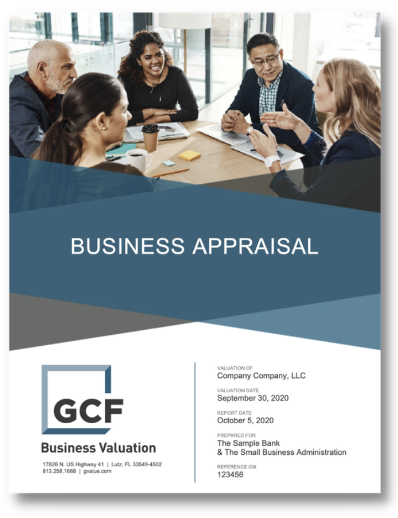
What Is a Business Appraisal?
A Business Appraisal, sometimes referred to as a Conclusion of Value, is a more comprehensive valuation prepared by a qualified, independent appraiser under professional standards. It is designed for situations where the valuation must be more fully supported, more broadly relied upon, and better suited to withstand scrutiny from lenders, investors, attorneys, accountants, taxing authorities, courts, or other stakeholders. GCF provides Business Appraisals in Restricted Use, Summary, and Complete report formats depending on the needs of the engagement.
Key characteristics:
- Thorough analysis: The appraiser analyzes financial performance, normalizes earnings, evaluates company-specific, industry, and economic factors, and applies the appropriate valuation approaches—income, market, and, when relevant, asset—to arrive at a supported conclusion.
- Broader use and stronger support: A Business Appraisal is typically the right choice when the valuation will be relied on by third parties, used in financing, tied to a formal transaction, or expected to satisfy regulatory, legal, tax, or governance-related requirements.
- Flexible reporting formats: Depending on the purpose and intended use, a Business Appraisal may be delivered as a Restricted Use, Summary, or Complete report while still maintaining the level of support appropriate for the engagement.
When a Calculation Report Is Usually Enough
There are situations where a Calculation Report is the pragmatic choice, especially earlier in the process or when the valuation is being used for internal guidance rather than formal third-party reliance.
A Calculation Report may be appropriate when:
- The valuation is for internal planning or preliminary analysis: Business owners, buyers, lenders, and advisors may use a Calculation Report to assess value, test assumptions, or evaluate a potential opportunity before committing to a fuller appraisal engagement.
- You are screening a transaction: A Calculation Report can help determine whether a proposed price or structure appears reasonable before investing in a more comprehensive Business Appraisal.
- The use is internal or limited: The result is intended for internal decision-making, planning, or early-stage evaluation—not for satisfying a formal lender requirement, tax matter, litigation need, or other third-party standard.
- The risk and complexity are relatively low: When the transaction is straightforward, the exposure is limited, and the valuation is not expected to serve as the primary support for a more formal proceeding, a Calculation Report may be sufficient.
In these situations, the lower cost and faster turnaround of a Calculation Report can be attractive, provided everyone understands its narrower scope and limitations.
When You Need a Business Appraisal
Once a transaction becomes more complex, more consequential, or more likely to be reviewed by outside parties, the risk of relying on a limited-scope valuation increases sharply. That is when a Business Appraisal becomes the more appropriate and defensible choice.
A Business Appraisal will often be required or strongly recommended when:
- Financing or underwriting requirements are triggered: In many SBA and commercial lending situations, an independent business appraisal is required once deal structure, financing levels, or related-party considerations cross key thresholds.
- Goodwill and cash flow drive the deal: When a significant portion of the value is intangible, a more rigorous income and market-based analysis is usually needed to support the price and the underlying assumptions.
- The transaction could face scrutiny or challenge: Partner disputes, divorce, estate matters, gift planning, litigation, shareholder issues, and other contested situations generally call for a more fully documented appraisal.
- The valuation will support a formal filing, reporting obligation, or governing decision: If the valuation may need to be defended before the IRS, courts, boards, investors, auditors, or other formal stakeholders, a Business Appraisal is typically the better fit.
How to Decide on Your Next Loan or Deal
The decision rarely comes down to price alone. It comes down to matching the level of analysis and documentation to the purpose, complexity, and level of reliance associated with the engagement.
A simple framework:
- Ask whether the valuation will be relied on by third parties, used to support a formal transaction, or expected to hold up under scrutiny. If the answer is yes, a Business Appraisal is usually the better choice.
- For financing transactions, consider whether lender, investor, or other underwriting requirements call for an independent appraisal rather than a more limited valuation engagement.
- Consider the stage of the process: Early in discussions, a Calculation Report may help screen opportunities and frame expectations before a full appraisal is warranted.
- Identify the intended users and intended use: If the valuation is meant for a board, investor group, legal matter, tax purpose, lender file, or other formal audience, a Business Appraisal is generally the appropriate path.
GCF helps buyers, sellers, lenders, and advisors navigate these decisions by offering both Calculation Reports for internal and limited-use needs and Business Appraisals for transactions and matters that require a more fully supported valuation.
If you are determining which level of valuation you need, visit GCF’s business valuation page and request a discussion so our team can recommend the right scope for your specific deal or situation.

Keep Learning About Business Valuations
How to Navigate The Business Valuation Process Successfully
The Great Debate: Business Valuation With or Without Inventory
What Is Business Valuation? Why & When You Need One
Our Accreditations
Your GCF Business Valuation appraisal team has one or more of the following business valuation accreditations:
 Accredited Senior Appraiser (ASA) – is recognized as having achieved the highest level of education, training, and report writing for business valuations. The ASA designation is the gold standard for a business valuation professional. (source: American Society of Appraisers)

Certified Business Appraiser (CBA) – a very prestigious credential in the eyes of all who are familiar with it as it earned the reputation of being a difficult credential to obtain. (source: National Association of Certified Valuators and Analysts®)
 Certified Valuation Analyst (CVA)
 Accredited in Business Valuation by the American Institute of CPAs (ABV by AICPA) – a credential granted exclusively by the AICPA to qualified valuation professionals who demonstrate expertise in valuation through knowledge, skill, experience, and adherence to professional standards. (source: American Institute of CPAs)
Accredited in Business Valuation (ABV) – credential is granted exclusively by the AICPA to CPAs and qualified valuation professionals who demonstrate considerable expertise in valuation through their knowledge, skill, experience, and adherence to professional standards. (source: American Institute of CPAs)
- Certified Public Accountant (CPA)
Over 25 years of experience and expertise in business valuations and appraisals. An accredited appraiser receives extensive training, remains in good standing, and follows specific industry practices to determine the value of a business.
GCF’s Machinery and Equipment Appraisal Accreditations
 Expert Equipment Certified Appraiser (EECA) – Our appraisers are recognized with a deep understanding of valuation principles and extensive experience by the Institute of Equipment Valuation.
- Certified Machinery and Equipment Appraiser (CMEA) – a CMEA professional has the expertise and certification to conduct a third party machinery and equipment appraisal.